How U.S. Federal Artificial Intelligence (AI) policy is shaping agrifood systems: an integrative review
- Published
- 17 September 2026
- DOI
- 10.3389/frai.2026.1881767
- Views
- 3
- Reads
- 0
- Citations
- 0
Abstract
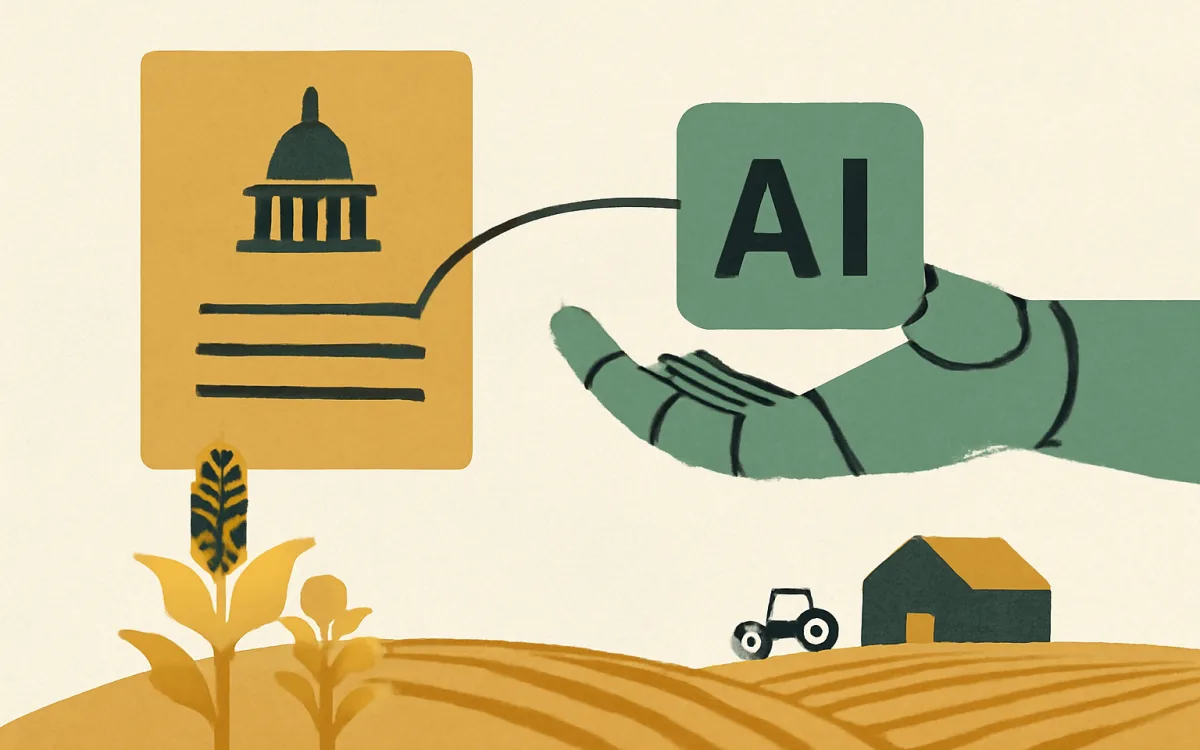
Artificial intelligence (AI) is increasingly shaping how agrifood systems function in the United States, yet the role of federal policy in guiding its use, oversight, and broader consequences is still not well defined. This study explores how current U.S. federal AI policies support-or limit-the advancement of agrifood systems by synthesizing evidence from publicly available policy documents. Using a focused search strategy and qualitative content analysis, we reviewed nine federal policy documents released through September 2025 to identify key priorities and overlooked areas relevant to agriculture. Our analysis revealed six recurring themes: environment, precision agriculture, workforce development, governance, technological infrastructure, and partnership. The findings show that federal AI policy places considerable emphasis on building infrastructure, strengthening workforce capacity, and establishing governance frameworks. At the same time, less attention is given to environmental trade-offs, equitable access for small- and mid-scale producers, and the place specific conditions that shape agricultural practice. Notably, tensions emerge between policies that promote rapid expansion of AI infrastructure and those aimed at protecting environmental resources and strengthening climate resilience. Taken together, the results suggest that although agriculture is increasingly recognized within the national AI agenda, the lack of a coordinated, agriculture specific policy framework may lead to uneven adoption and unintended outcomes across the agrifood system. This study offers a synthesized policy foundation to support future research, inform decision making, and engage stakeholders in aligning AI innovation with more sustainable and equitable agrifood systems.
Continue reading this article
The abstract is always free. The full text, figures and PDF are available with a one-off purchase or an all-access subscription.
One payment, permanent access
- Full text and figures
- Permanent access, read any time
- Saved to your library
Every article, every field
- Unlimited reading
- All subject areas
- Cancel any time
Related research
 Full text requires access
Artificial intelligence for climate-health early warning systems in the Horn of Africa: opportunities, challenges, and a roadmap for action
Climate extremes, conflict, and population displacement converge in the Horn of Africa to accelerate outbreaks of climate-sensitive infectious diseases, wherea…
 Full text requires access
Mobility as climate change adaptation in South Africa: Exploring the legal and policy significance of artificial intelligence
This study explores the intersection of mobility, climate change adaptation and artificial intelligence (AI) in South Africa. As climate change impacts mobilit…
 Full text requires access
Application of Artificial Intelligence in analysing meteorological data for health research: A rapid review
Introduction: Artificial intelligence (AI) has rapidly advanced as a key analytical tool for processing complex datasets across disciplines, including environm…
 Full text requires access
From detection to action: artificial intelligence in integrated pest and invasive plant management
Global agriculture faces growing threats from pests, pathogens, and invasive species, intensified by climate change and biodiversity losses. Conventional appro…