From detection to action: artificial intelligence in integrated pest and invasive plant management
- Published
- 17 September 2026
- DOI
- 10.1007/s44307-026-00118-7
- Views
- 1
- Reads
- 0
- Citations
- 0
Abstract
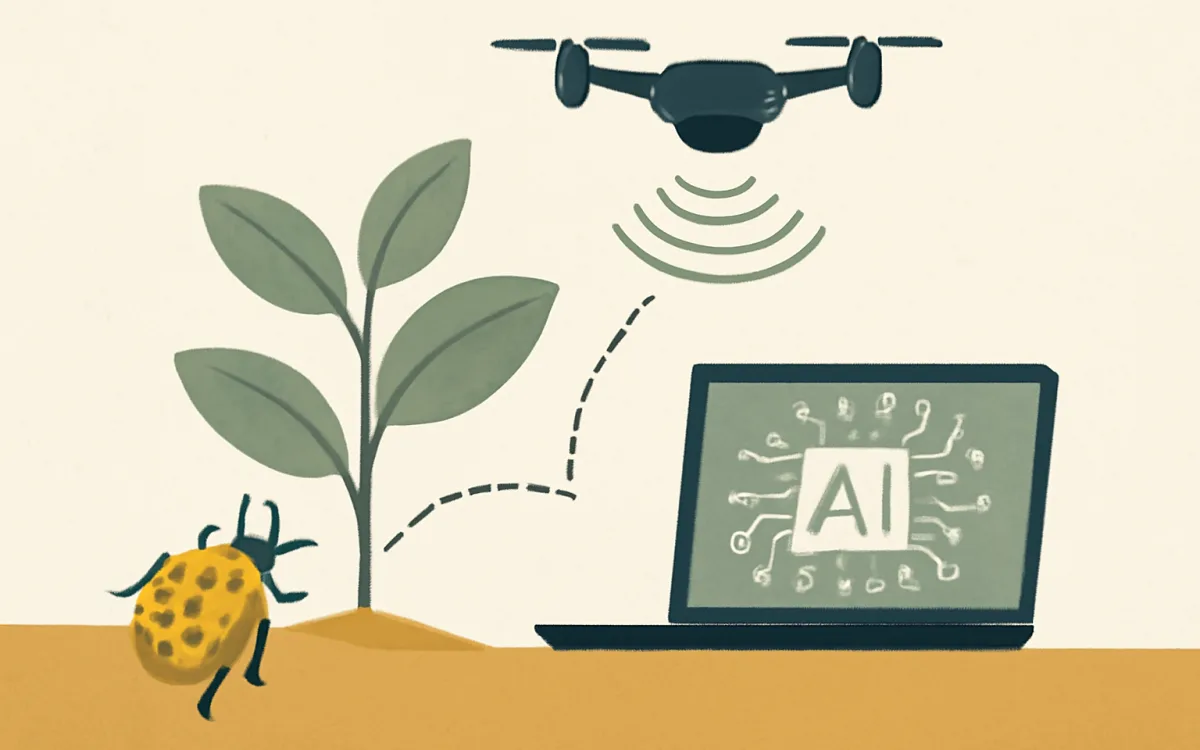
Global agriculture faces growing threats from pests, pathogens, and invasive species, intensified by climate change and biodiversity losses. Conventional approaches are limited in both precision and scale, and artificial intelligence (AI) is now reshaping integrated pest management (IPM). Modern agricultural monitoring leverages high-resolution observations, hyperspectral sensors, and the Internet of Things (IoT) to facilitate early detection for diseases. Hybrid AI systems can integrate multi-source data to enhance the accuracy of real-time monitoring of pest and disease dynamics, including the detection and tracking of sparse invasive populations and their biomass even under shifting climate scenarios. They further enable predictive forecasting and the optimization of management strategies. When AI-driven diagnostics are integrated with autonomous robotics, they form a robust framework for epidemic mitigation. Here, we provide a systematic macro-perspective review, bridging foundational AI mechanisms with actionable IPM intelligence. We analyze the evolution of agricultural AI from cross-modal architectures to multi-scale diagnostics and full-lifecycle interventions. Finally, we propose a framework for the global agroecological network, offering a sustainable path toward maximizing productivity while ensuring ecological resilience.
Continue reading this article
The abstract is always free. The full text, figures and PDF are available with a one-off purchase or an all-access subscription.
One payment, permanent access
- Full text and figures
- Permanent access, read any time
- Saved to your library
Every article, every field
- Unlimited reading
- All subject areas
- Cancel any time
Related research
 Full text requires access
Artificial intelligence for climate-health early warning systems in the Horn of Africa: opportunities, challenges, and a roadmap for action
Climate extremes, conflict, and population displacement converge in the Horn of Africa to accelerate outbreaks of climate-sensitive infectious diseases, wherea…
 Full text requires access
Mobility as climate change adaptation in South Africa: Exploring the legal and policy significance of artificial intelligence
This study explores the intersection of mobility, climate change adaptation and artificial intelligence (AI) in South Africa. As climate change impacts mobilit…
 Full text requires access
Application of Artificial Intelligence in analysing meteorological data for health research: A rapid review
Introduction: Artificial intelligence (AI) has rapidly advanced as a key analytical tool for processing complex datasets across disciplines, including environm…
 Full text requires access
Rethinking Dengue Preparedness in the Era of Climate Change, Urbanisation, and Digital Health: A Structured Narrative Review
Background and Objectives: Dengue is emerging as a multifaceted public health challenge that extends beyond traditional vector-borne disease frameworks. Climat…