Harnessing artificial intelligence in plant breeding: innovations in digital phenotyping and breeding methodologies
- Published
- 17 September 2026
- DOI
- 10.1007/s00122-026-05293-8
- Views
- 3
- Reads
- 0
- Citations
- 0
Abstract
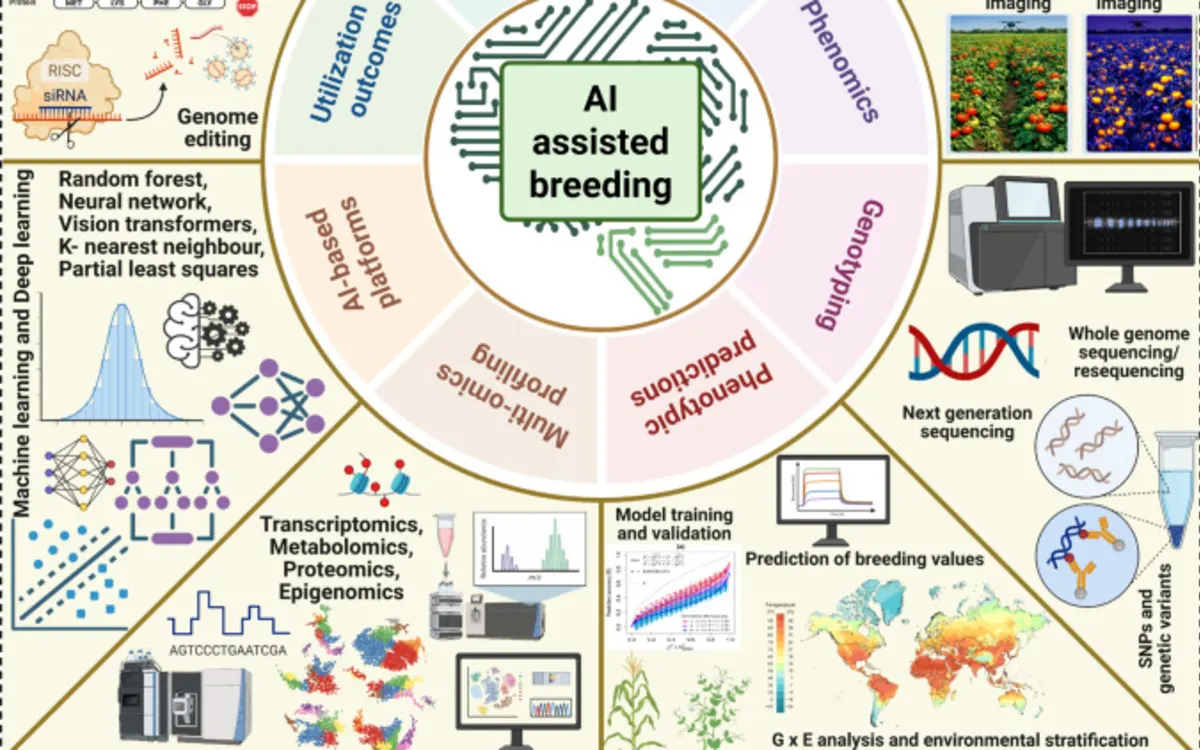
Agriculture plays a crucial role in the development of countries whose economies rely heavily on food production. In the face of climate change and growing global population, plant breeders are challenged to adopt more efficient crop improvement strategies. The advances in artificial intelligence (AI), particularly in large-scale data integration, analysis, and pattern recognition, have revolutionized several scientific disciplines, including plant breeding. In this review, we provide a comprehensive survey of the potential of AI tools in plant breeding with four key objectives: (i) revolutionizing high-throughput phenotyping, (ii) exploring AI-driven breeding methodologies beyond traditional approaches, (iii) optimizing breeding pipelines through improved modelling of genotype × environment × management interactions, and (iv) highlighting the limitations of AI in plant breeding and future directions. Case studies published during the past two decades illustrate successful implementations of AI-powered phenotyping and breeding frameworks for major traits across diverse crop species. Furthermore, AI tools show great promise in refining crop traits at the molecular level by increasing the accuracy and precision of emerging fields including gene editing and genomic selection. We emphasize the importance of interdisciplinary collaboration to maximize the benefits of AI in plant breeding programs and to support the sustainable and food-secure future. This review bridges the gap between AI and agricultural applications, offering a roadmap for researchers, industry professionals, and policymakers to harness information fusion and computational models for advancing precision agriculture. It will serve as a valuable resource for future plant breeding, accelerating crop improvement from phenotyping to genomic selection and breeding decision support.
Continue reading this article
The abstract is always free. The full text, figures and PDF are available with a one-off purchase or an all-access subscription.
One payment, permanent access
- Full text and figures
- Permanent access, read any time
- Saved to your library
Every article, every field
- Unlimited reading
- All subject areas
- Cancel any time
Related research
 Full text requires access
Artificial intelligence for climate-health early warning systems in the Horn of Africa: opportunities, challenges, and a roadmap for action
Climate extremes, conflict, and population displacement converge in the Horn of Africa to accelerate outbreaks of climate-sensitive infectious diseases, wherea…
 Full text requires access
Mobility as climate change adaptation in South Africa: Exploring the legal and policy significance of artificial intelligence
This study explores the intersection of mobility, climate change adaptation and artificial intelligence (AI) in South Africa. As climate change impacts mobilit…
 Full text requires access
Application of Artificial Intelligence in analysing meteorological data for health research: A rapid review
Introduction: Artificial intelligence (AI) has rapidly advanced as a key analytical tool for processing complex datasets across disciplines, including environm…
 Full text requires access
From detection to action: artificial intelligence in integrated pest and invasive plant management
Global agriculture faces growing threats from pests, pathogens, and invasive species, intensified by climate change and biodiversity losses. Conventional appro…